Introduction
Most countries in the world have a written constitution that clearly explains how their government operates. These documents usually define the powers of government institutions, the rights of citizens, and the structure of political authority.
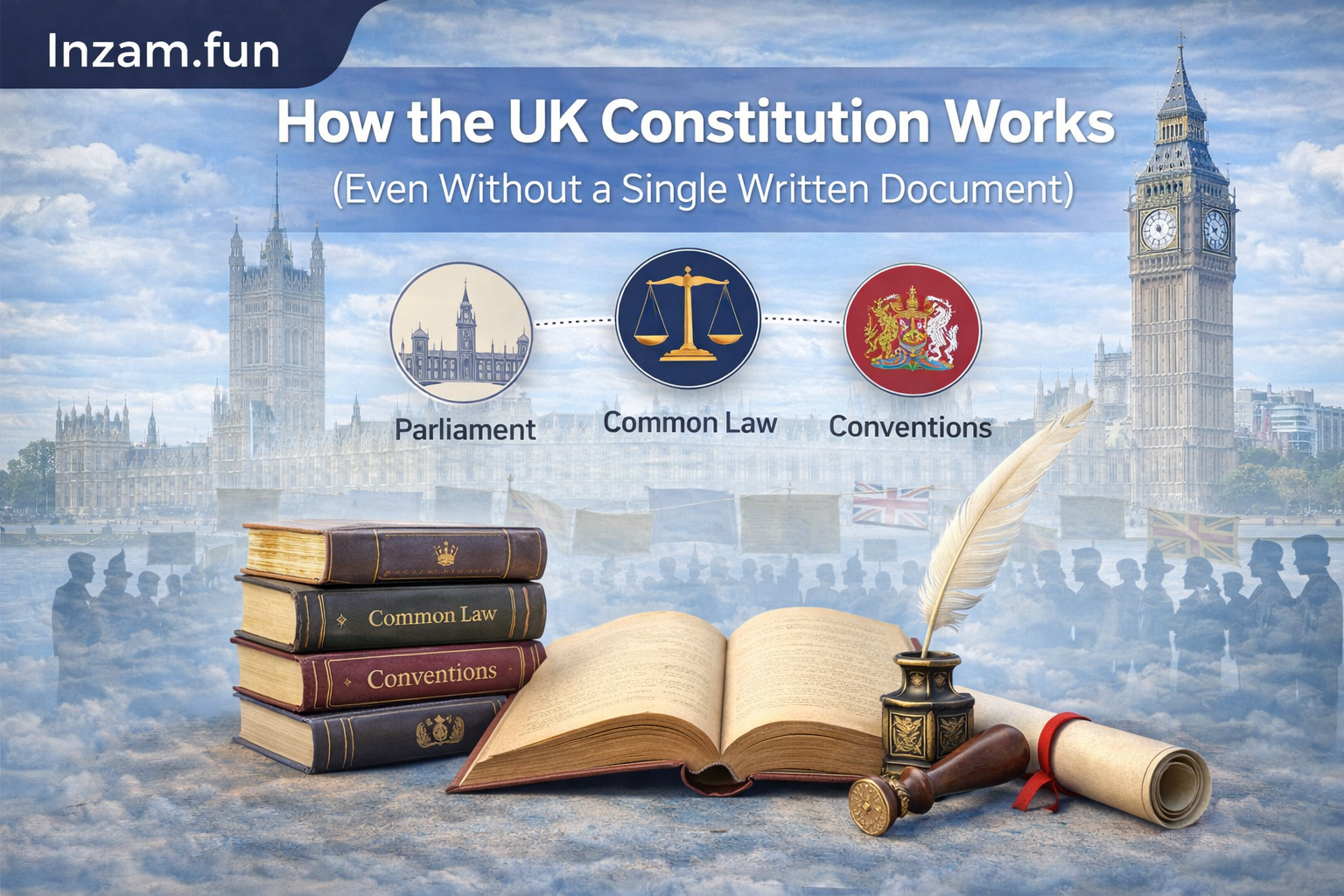
The United Kingdom, however, is different. It does not have a single written constitutional document. Instead, the UK constitution is made up of a collection of laws, historical documents, legal decisions, and political traditions developed over many centuries.
Despite the absence of one formal document, the British constitutional system functions effectively and provides the framework that guides how the country is governed.
Understanding how this system works helps explain the unique nature of the UK’s political structure.
What Is a Constitution?
A constitution is a set of rules and principles that define how a country is governed.
It usually explains:
- The structure of government institutions
- The distribution of political power
- The rights and responsibilities of citizens
- The relationship between the government and the people
In many countries, these rules are written in a single official document. In the United Kingdom, however, the constitution exists as a combination of different legal and historical sources.
Sources of the UK Constitution
The British constitution is formed from several important sources. Together, these elements create the legal and political framework that guides the country’s governance.
Statute Law
One of the most important sources of the UK constitution is statute law, which refers to laws passed by Parliament.
Parliament has the authority to create or modify constitutional rules through legislation. This means that the constitution can evolve over time as new laws are introduced.
Examples of important constitutional laws include legislation that defines voting rights, parliamentary powers, and government responsibilities.
Historic Constitutional Documents
Several historic documents have played a major role in shaping the UK constitution.
One of the most famous examples is the Magna Carta (1215). This document introduced the principle that the monarch must follow the law and cannot exercise unlimited power.
Another important document is the Bill of Rights (1689), which established the authority of Parliament and limited the powers of the monarchy.
These historical agreements helped create the foundation of modern British constitutional principles.
Common Law
Another important source of the UK constitution is common law.
Common law refers to legal principles developed through court decisions over time. Judges interpret laws and apply them to specific cases, which gradually shapes legal standards and constitutional practices.
Through judicial decisions, courts help clarify how constitutional rules operate in practice.
Constitutional Conventions
In addition to written laws, the UK constitution also relies on constitutional conventions.
These are unwritten rules that guide political behavior and government practices.
Although conventions are not legally enforceable in courts, they are widely respected and followed because they maintain the stability of the political system.
For example, one important convention is that the monarch acts on the advice of elected government leaders rather than making independent political decisions.
Parliamentary Sovereignty
One of the key principles of the UK constitution is parliamentary sovereignty.
This principle means that Parliament has the ultimate legal authority to create or change laws.
Unlike some countries where constitutional courts can overturn legislation, the UK Parliament has the power to modify almost any law, including constitutional rules.
Because of this, the constitution remains flexible and capable of adapting to changing political circumstances.
The Role of the Monarchy
The United Kingdom is a constitutional monarchy, meaning the monarch serves as the official head of state while political power is exercised by elected representatives.
Although the monarch formally approves legislation and appoints the Prime Minister, these actions follow established constitutional conventions.
In practice, political decisions are made by the government and Parliament rather than the monarch.
This arrangement allows the monarchy to maintain a symbolic and ceremonial role while democratic institutions manage governance.
The Role of the Courts
The judicial system also plays an important role in maintaining constitutional balance.
Courts interpret laws, ensure that government actions follow legal procedures, and protect the rights of individuals.
Although courts cannot override parliamentary sovereignty, they can review government decisions and ensure that public authorities act within the limits of the law.
This helps maintain fairness and accountability within the political system.
Why the UK Constitution Is Flexible
One of the most distinctive features of the UK constitution is its flexibility.
Because the constitution is not contained in a single written document, it can evolve through legislation, court decisions, and political practice.
This flexibility allows the system to adapt to social changes, political developments, and new challenges without requiring a formal constitutional amendment process.
Over time, this adaptability has helped the UK maintain political stability while gradually expanding democratic rights.
Conclusion
The United Kingdom’s constitutional system is unique because it operates without a single written document. Instead, it is built upon a combination of laws, historical agreements, judicial decisions, and long-standing political conventions.
Together, these elements form a flexible framework that guides how the government functions, how power is distributed, and how democratic accountability is maintained.
Although the structure may appear complex at first, the UK constitution demonstrates how a political system can evolve over centuries while continuing to support democratic governance and legal stability.