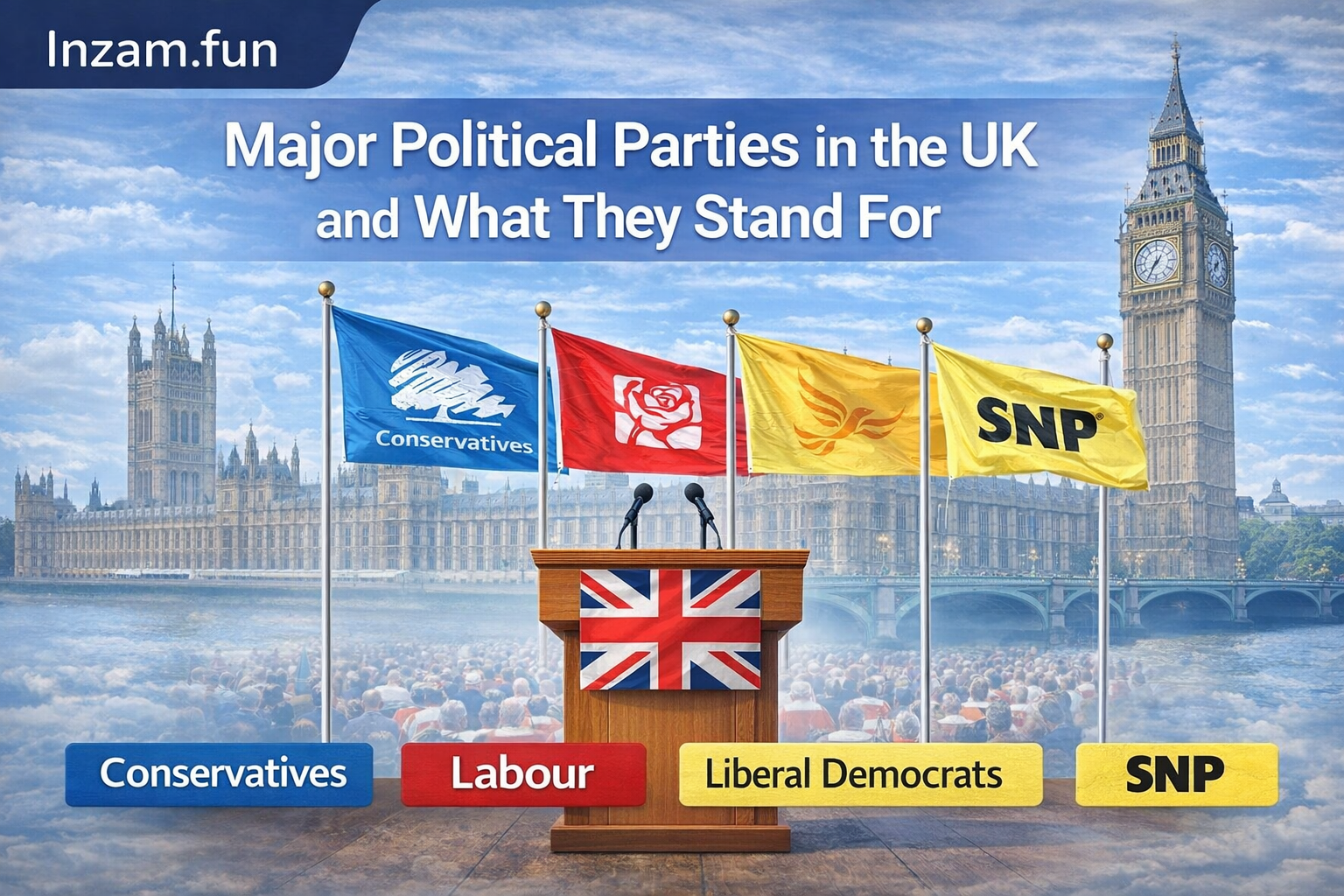
Introduction
Political parties play a central role in the democratic system of the United Kingdom. They organize political ideas, represent different viewpoints, and compete in elections to form the government.
In the UK, political parties help shape national policies, influence legislation, and give voters a clear choice about how the country should be governed. Each party has its own principles, priorities, and approach to key issues such as the economy, healthcare, education, and international relations.
While there are many political parties in the United Kingdom, a few major parties have historically dominated national politics.
Understanding these parties and their general positions helps explain how political competition and debate function in the British political system.
The Conservative Party
The Conservative Party is one of the oldest and most influential political parties in the United Kingdom. Often referred to simply as the “Conservatives,” the party has played a major role in British politics for more than a century.
The Conservative Party generally supports policies that emphasize economic stability, free markets, and a strong national economy.
Some of the key priorities often associated with the party include:
- Encouraging business growth
- Promoting lower taxation in certain sectors
- Maintaining national security
- Supporting traditional institutions
The party has led several governments throughout modern British history and continues to be a major force in UK politics.
The Labour Party
The Labour Party is another major political party in the United Kingdom and has historically been the primary rival to the Conservative Party.
Founded in the early 20th century, the Labour Party was originally created to represent the interests of working people and trade unions.
The party generally supports policies focused on social welfare, public services, and reducing economic inequality.
Common priorities associated with the Labour Party include:
- Strengthening public healthcare systems
- Supporting workers’ rights
- Expanding education opportunities
- Investing in social programs
Over time, the party has evolved to include a broad range of political views while maintaining its focus on social and economic fairness.
The Liberal Democrats
The Liberal Democrats are a political party that promotes policies centered on civil liberties, democratic reforms, and social equality.
The party was formed through a merger of earlier political groups that supported liberal political ideas.
The Liberal Democrats often advocate for:
- Electoral reform
- Protection of individual freedoms
- Environmental sustainability
- International cooperation
Although the party typically holds fewer seats than the two major parties, it has occasionally played a key role in coalition governments and parliamentary negotiations.
The Scottish National Party (SNP)
The Scottish National Party, commonly known as the SNP, is a political party that primarily operates in Scotland.
The party’s central objective is to promote Scottish interests and support greater political independence for Scotland.
The SNP focuses on policies that address regional priorities, including economic development, public services, and cultural identity within Scotland.
Because Scotland has its own devolved parliament, the SNP plays a particularly significant role in Scottish politics while also participating in the UK Parliament.
Other Political Parties
In addition to the major parties, several smaller political groups also participate in the UK political system.
These parties often focus on specific regional interests or particular policy issues.
Some smaller parties emphasize topics such as environmental protection, regional governance, or alternative economic approaches.
Although these parties may hold fewer seats in Parliament, they contribute to political debate and represent diverse viewpoints within the democratic system.
The Role of Political Parties in Elections
Political parties compete in elections to gain seats in the House of Commons.
During election campaigns, parties present their policies and proposals in documents known as manifestos. These manifestos explain what the party plans to do if it forms the government.
Voters review these proposals and choose the candidates who best represent their views.
The party that wins the largest number of seats in the House of Commons usually forms the government, while other parties serve as opposition or supporting groups in Parliament.
Opposition and Democratic Balance
An important part of the UK political system is the presence of a strong opposition.
The largest party that is not in government becomes the Official Opposition. Its role is to challenge government decisions, question policies, and provide alternative ideas.
This system encourages political accountability and ensures that government actions are closely examined.
Healthy competition between parties helps maintain balance within the democratic process.
Why Political Parties Matter
Political parties help organize political participation in a complex society.
They allow citizens to support ideas and policies that match their beliefs, while also providing structure to the parliamentary system.
Parties recruit candidates, develop policies, and engage with voters across the country.
Without political parties, it would be much more difficult to organize elections, form governments, or maintain effective political debate.
Conclusion
Political parties are a vital part of the democratic system in the United Kingdom. Through elections, policy debates, and parliamentary discussions, they shape the direction of national decision-making.
Major parties such as the Conservative Party, the Labour Party, and the Liberal Democrats offer different visions for how the country should be governed, while regional parties like the Scottish National Party represent important local perspectives.
Together, these political groups create a dynamic political environment where ideas compete, policies evolve, and citizens have the opportunity to influence the future of their country.